Weather Alert in Alaska
Winter Storm Warning issued March 20 at 1:00PM AKDT until March 21 at 7:00PM AKDT by NWS Juneau AK
AREAS AFFECTED: Haines Borough and Klukwan
DESCRIPTION: ...ANOTHER PERIOD OF SNOW FOR THE CENTRAL AND NORTHERN PANHANDLE THIS WEEKEND... .Confidence is increasing on seeing a more significant round of snow this weekend as cold temperatures aloft remain in place and another round of moisture moves in. There remains some uncertainty for snow accumulations at the surface as Saturday afternoon temperatures at sea level are reaching into the mid 30s to around 40 due to increasing daylight and sun angle. However, temperatures aloft are still very favorable for accumulating snow amounts. If the heavier precipitation rates are significant enough to overcome the warmer surface temperatures, snow accumulations will be greater. But if the temperatures are able to overcome the precipitation rates, snowfall will be limited as it melts by the time it reaches the surface. This will need to be monitored for any changes in potential snow accumulation. The orientation of the low and where the showers move into the panhandle will also impact the snow amounts, with how northward and inland the heavier moisture will push and how organized the bands of snow are expected to be when moving through this weekend. Highest snow rates are expected Saturday morning before warmer temperatures in the afternoon begin to limit snow accumulation. * WHAT...Heavy snow expected. Total snow accumulations of 5 to 9 inches. * WHERE...Haines Borough and Klukwan. * WHEN...From 4 AM to 7 PM AKDT Saturday. * IMPACTS...Travel will be very difficult. * ADDITIONAL DETAILS...Highest snow rates will be near Haines and Mud Bay with lower snow rates farther up the Haines Highway. Though snow rate could increase again near Haines Customs near the international border.
INSTRUCTION: If you must travel, keep an extra flashlight, food, and water with you in case of an emergency. People are urged to prepare their property before the onset of winter weather. For the latest road conditions, where available, call 5 1 1 or visit 511.alaska.gov.
Want more detail? Get the Complete 7 Day and Night Detailed Forecast!
Current U.S. National Radar--Current
The Current National Weather Radar is shown below with a UTC Time (subtract 5 hours from UTC to get Eastern Time).

National Weather Forecast--Current
The Current National Weather Forecast and National Weather Map are shown below.

National Weather Forecast for Tomorrow
Tomorrow National Weather Forecast and Tomorrow National Weather Map are show below.

North America Water Vapor (Moisture)
This map shows recent moisture content over North America. Bright and colored areas show high moisture (ie, clouds); brown indicates very little moisture present; black indicates no moisture.

Weather Topic: What are Mammatus Clouds?
Home - Education - Cloud Types - Mammatus Clouds
 Next Topic: Nimbostratus Clouds
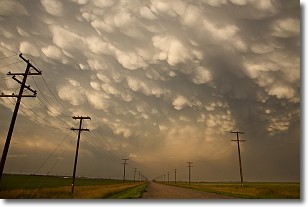
A mammatus cloud is a cloud with a unique feature which resembles
a web of pouches hanging along the base of the cloud.
In the United States, mammatus clouds tend to form in the warmer months, commonly
in the Midwest and eastern regions.
While they usually form at the bottom of a cumulonimbis cloud, they can also form
under altostratus, altocumulus, stratocumulus, and cirrus clouds. Mammatus clouds
warn that severe weather is close.
Next Topic: Nimbostratus Clouds
Weather Topic: What is Precipitation?
Home - Education - Precipitation - Precipitation
 Next Topic: Rain
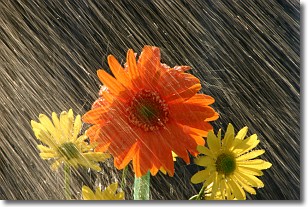
Precipitation can refer to many different forms of water that
may fall from clouds. Precipitation occurs after a cloud has become saturated to
the point where its water particles are more dense than the air below the cloud.
In most cases, precipitation will reach the ground, but it is not uncommon for
precipitation to evaporate before it reaches the earth's surface.
When precipitation evaporates before it contacts the ground it is called Virga.
Graupel, hail, sleet, rain, drizzle, and snow are forms of precipitation, but fog
and mist are not considered precipitation because the water vapor which
constitutes them isn't dense enough to fall to the ground.
Next Topic: Rain
Current conditions powered by WeatherAPI.com